A TURTEL DOVE: THE RECREATION OF A PIECE BY MARY, QUEEN OF SCOTS


BACKGROUND
·
GLOSSARY
o
EMBROIDERY TERMS
o
DESIGN TERMS
·
HISTORY
o TAPESTRIES
o BOOKS
o CREATION PROCESS
·
EXEMPLARS
·
RECREATIONS
o SUPPLIES
o STITCHES
o PATTERNING
o PROCESS/ METHODS
·
BIBLIOGRAPHY
·
FURTHER PROJECT PICTURES
GLOSSARY
·
EMBROIDERY TERMS[1]
o CROSS STITCH: English method- a single cross
stitch is completed, one diagonal stitch over another, before moving on to
complete the second stitch, and so on.”
o CROSS STITCH: Danish method- one diagonal
stitch of the required number of cross stitches is made before returning in the
opposite direction to complete the second set of diagonal stitches over the
first diagonal row of stitches.”
o “Continental tent- stitch is worked in
horizontal or vertical rows and makes a diagonal stitch on the back, longer
than that on the front”
o “Half cross tent stitch- worked in rows and
makes a vertical stitch on the back.”
o BASKETWEAVE TENT STITCH- “diagonal stitch,
usually worked across a single intersection of canvas from bottom left to top
right.”
o TRAMMED- a long thread laid along the top of
the canvas and the tent stitches cover this thread to provide slightly padded
coverage. Tramming would normally be
used with half cross tent stitch (which has the smallest amount of thread on
the reverse).
o “Examination of the contemporaneous Hardwick
Hall embroideries has found that both basketweave and (trammed) half cross tent
stitches were used.”
BACKGROUND
For
the past 5 years, I have been on a journey of learning the “ins and outs” of counted work (specifically cross
stitch and tent stitch) and how it could be applied to household furnishings. I
have had a long fascination with the pieces created by Mary, Queen of Scots in
her time of captivity in England, and was amazed to see how it wove its way
back to the French Court. At the same time, I was able to see how table carpets
and bed hangings also had been created with the same basic stitches. This
projected allowed me to “flex’ my patterning skills, as the extant piece is
missing large parts of its colored thread, however the ground fabric was then
visible for inspection. I was able to see how Queen Mary was able to pass the
time with these creations as i stitched away at my desk at work, passing the
time in meetings and in between tasks.
On December 8th, 1542, a baby girl was born to James V
of Scotland and Marie de Guise. Upon his death 6 days after her birth, Mary
became Queen of Scotland. To keep her safe as well as to form an alliance,
Mary, along with her household, was moved to France to be raised with the
French Royal Children (Swain, 11, 12).
[1] All embroidery definitions are taken from the
Royal School of Needlework Stitchbank (Stitch Wall - RSN Stitchbank)
court.
While she did not have much time to create in the role of Queen of Scotland,
Mary quickly picked her work back up in England after escaping Scotland in 1568
(Swain, 36, 37, 121). To Prevent an uprising of the Catholic population, Queen
Elizabeth I of England allowed Queen Mary to stay in England however as a
prisoner. Along with her captor Bess of
Hardwick, Dozens of embroidered pieces were created (Swain, 102).
The
pieces are a mix of mottos and Impresas, animals and flowers. Mary made gifts
for friends and lovers, and spent dozens of hours creating these pieces, using
them as an outlet when she was no longer allowed outside. Years after her
death, many pieces of her work were turned into hangings, and while we may not
know the original intent of the works, it is a mystery that is still being
studied today. I believe they were a mix of concepts; she needed things to keep
her hands busy. She wanted to make political statements and she wanted to
communicate in secret. Since Her letters were more than likely intercepted, she
could try to get her point across in her embroidery. I also believe they had a
practical point for decorating her space, as everything had to be made by hand,
and this gave her a level of control about how her rooms represented her.
For years I have been fascinated with these pieces. Their texture and deep meaning are created with just a few simple stitches. Each piece has a message or meaning based upon how Mary was feeling or wanted to tell the receiver of the piece. For example, a piece known as the Norfolk panel shows a hand cutting down some vines while others on the vine are flourishing. The vines are believed to represent Elizabeth whom has not married and had no children vs Mary whom has been married several times and has her own blood heir (Swain, 75). According to Medieval Beastiary; Beasts website, Turtle doves historically had several significant attributes including loyalty, as they only have one mate for life, survive in solitude, and is a representation of the Holy Church. We are not aware of what the animal recreation pieces are for; it is possible they were gifts for children, or just completed to work on skills and pass the time.
·
DESIGN TERMS
o SLIPS- embroidered details worked on a
separate piece of fabric or canvas, then cut out and appliqued to the main
design (typically birds or flowers)

Meg Andrews, Elizabethan and Stuart 'Slips'
o EMBLEMS- a
symbolic imagery and an accompanying motto, challenging the viewer to work out
the relationship in a verse-epigram set up (Bath,7)

o IMPRESE/IMPRESA- a image and motto together
expressing an intention that the creator uses to describe a certain situation.
In this piece it is believed that Elizabeth is represented as the barren vine,
and Mary is the fruitful vine, as she has an heir and is young enough to have
more children. This was sent as a secret message to the Duke of Norfolk in 1572
(Bath, 58)
Prison Embroidery; V&A museum website


HISTORY
o
TAPESTERIES
§
Marian Hanging
§
Shrewsbury Hanging
§
Oxburgh Valance
§ Made
up of over 100 panels
§ Whole
tapestry size 2270mm-2940mm
§
Individual pieces are approx. 11.81”-87”
§
Octagonal and cruciform shaped pieces
Many
of the pieces created by both Mary and Bess (or members of their household)
were taken by Lady Arbella Stuart, granddaughter of Bess of Hardwick, and
mounted approximately around 1611. (Bath 12, 13). The pieces I recreated for
both AEthelmearc A&S Champs as well as Pennsic Champs are both from the
Marian Hanging, Named after Mary Queen of Scots. The Marian Hanging are pieces
attributed to Mary Queen of Scots, The Shrewsbury hanging are pieces created
around the Earl of Shrewsbury as well as the Cavendish hanging related to
Bess’s second husband the Earl of Cavendish (V&A Museum).

Historical Recreation; Top
C. Gesner Icones Animalium; bottom (Swain, 69)

Historical recreation; top
L’Histoire de la Nature des Oyseaux; bottom (Swain, 68)


La Nature et Diversite des Poissons; left
(Swain, 66) with historical recreation; right
Other Literature that became popular during
the time for patterning making includes:
§
Devises heroiques (1557) by Claud Paradin
§ Birds
of Paradise (1560’s) by Conrad Gesner
§ La
Nature et Diversite des Poissons (1555) Pierre Belon
§
L’Histoire de la Nature des Oyseaux (1555) by Pierre Belon
§
Devises Royales (1621) by Adrien d’Amboise {is it possible that his father, Francois
d’Amboise helped to start the book earlier?}
§
Emblemata by Hadrianus Junius
§
Claude Paradin’s Aesopic fables
§ Royal
coins, engravings, paintings and other art pieces are documented to show these
designs. They could have been copied or described and sent to Queen Mary where
she then recreated and altered them.

Extant example: An Unicorne

Extant
Example: A motto piece
 Extant Example found on
V&A website
Extant Example found on
V&A website 
A Motto: found at V&A Museum Website
RECREATION
o
SUPPLIES
§ Modern tapestry needle
§ Zweigart even weave 32 count linen fabric
§ DMC wool
§ Appleton wool
o STITCHES
§ Cross stitch
§ Tent stitch
o PATTERNING
§
Computer altered to approx. 8”, mapped on graph paper and transferred onto
fabric

My pattern, drawn from enlarged picture taken from extant piece
According to Margaret Swain in Her Book “The
Needlework of Mary Queen of Scots” the extant pieces could take anywhere from a
month of work for a smaller piece to several months for the larger, more
intricate pieces. Mary used “fine Canvas (36 threads to the inch)” per Swain as
well (pg 83 and 84). I have experimented with several different ground fabrics
up to this point, including lower count aida cloth, looser weave linen fabric
up to the 32 count linen this was completed on. I based the size of the projects
off of the descriptions found on the V&A museum. The average piece of the
cruciform appeared to be to be about 26.5cm by 26cm or 10 inches by 10.4
inches. While the pieces were traditionally created in metal and silk on linen
(Swain pg 84), I personally do not use silk, wool was another historical
resource used, as can be seen on the embroidered table carpet fragment at The
Met website and is also my preferred
form of thread. I was not able to find a thread gage in any of my sources, i
did discover that tapestry weight presents with a more “full cover” than
something of a lighter or thinner spin like 2/20. For the more delicate
threads, i did double them up for a heavier material and i did not notice a
significance between 1 layer of a heaver thread vs the doubling up of a
lighter.

Exemplar
of an embroidered table carpet, made of wool and silk (The Met Museum)
I
attempted to color match the best I could between online color swatches of
materials to the extant pieces colors. It was quite a bit of trial and error, I
believe the colors are as close as possible. While the dove has some spots of
color left (legs, eye, neck, partial wing), most of the color is missing and
what you mainly see is the ground fabric. To choose my colors to create the
bird I did a general internet search for European Turtle Dove and based my
colors around those images. As for needles, I stayed with my traditional
blunted modern tapestry needed. I was having issues with my historical needle
that I was gifted not sliding between the ground fabric threads as nicely as
the modern needle. I do want to continue my search for a more historical needle
and see how that changes the lay of the thread.
While practicing on other designs, I have
tried manual manipulation techniques on the computer as well as a projector.
Manual Manipulation caused severe blurring as well as distortion. The projector
works well for me for line drawings, however with color pictures it also caused
too much distortion for my preference. In the end I ended up transferring a
copy of the image from the V&A museum website into a word document. From there, I used the program's image adjuster
to increase the height of the design to 5”. I knew once I added in the outside
designs and altered the cruciform shape to needed size, it would reach the 10”
goal. In the future, I believe this is the method I will use the most as it is
the easiest to control the size you would like the images to be sized to.
Using a modern light box, I was able to get the piece transferred using black marking pens. Historically, free hand or a pouncing method would have been used. Free hand is not a skill I am strong at, and with both children and pets with no large spaces to work, pouncing is not a method i would feel comfortable trying. To pounce, pin-sized holes would be marked along the pattern; then once laid upon the fabric, a chalk like substance in a bag would be taped against the pattern leaving being small marks on the ground fabric below. Once the whole project was covered this way and the pattern removed, the dots could be connected for the project outline

PROCESS/ METHODS
While it is sad that this piece is not in the best of
shape, it is helpful in other ways, as it opens up the ground fabric and
stitches to allow closer inspection.

Here
you can see that the ground fabric gathers nicely in a 2 thread grouping as
well as the black outline stitches in
cross stitch. You can also see in the photo below how it appears that the
colored filling stitches all appear to be one thread all lined up the same
direction. Because of these, I decided to outline the project in cross stitch
and fill in with tent stitch

Closeup of blue background, white
throat patch and bird coloring showing only one slant for tent stitch
Starting with the bird, I went in a 2x2 thread fashion starting at the top of its head and working around. Even though I had graphed the design, I still had to adapt the lines as I worked. Although compared to previous projects I did not have to shift many. Historically these pieces would have been placed on a frame if they were too large to be held in the hand. As I embroider a lot at my desk during work hours, I need a small frame set up. An 8” Q snap frame is my preference. I have tried scroll frames in the past, however they are too large for my needs, as well as I have tension issues while working on them.

Progress photo for outline of project
Once
I finished the bird, I moved on to the branches, and then the leaves and
acorns. I finished the four corner outside pieces as well before I moved onto
the cruciform pattern.


Once
completing the bird, I moved onto the surrounding branch, leaves and acorns.
The banner I completed the letters with the rest of the black background and
finished the fill prior to moving to the background.
Due to the fact that the pieces were mounted to the
green velvet sometime in the late 17th century by one of Elizabeth
of Shrewsbury descendants (possibly Alathea Talbot) we can only make
presumptions on what they might have looked like before. (Swain, M pg 103).
Michael Bath has some very nice examples in their book “Emblems for a Queen”
which I used as my basis for the outer designs of my project. We can see how
the below pieces had more to the background than just the cruciform giving it a
more uniform shape as well as the feel of nature. The flowers and other animals
seem to be a common theme with these pieces. M. Swain has a picture in her book
“The Needlework of Mary Queen of Scots of how the pieces are displayed as of
the book's publication in 1986. It is possible that many were ruined and that
is why they were cut down, however I have not found exact documentation on if
that is the reason or not. There are also no records that I have been able to
find on why they were created or their original intent. Michael Bath in his
book ‘Emblems for a Queen’ does state “This shape coding for different types of
subject matter is not found in any other embroidery of this period, but is
rather, a unique signature of the work of these two women and one of the clearest
signs of the remarkable community of taste that characterises their work.” So
it's possible, they were attempting to make as many pieces as possible and ran
out of time before Mary's death, and Elizabeth's divorce before the pieces
could finally be put together.

 Extant piece showing unaltered
background
Extant piece showing unaltered
background 

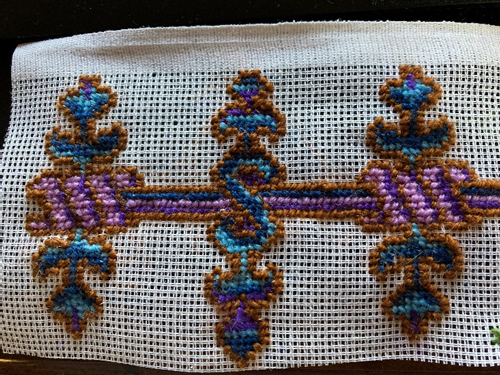
Using
the pattern book “A Schole-House For The Needle” by John and Elizabeth Mason, I
selected patterns that I felt complimented the main pattern as well as were
similar to the full extant patterns above. I also chose a neutral 2 shade gray
to highlight the colors in the project.
CONCLUSION
My
goal for this project was to show how counted work (specifically cross stitch
and tent stitch) was used historically. I wanted to show my skill in
patternmaking as well as how my research could “fill in the gaps” on pieces
that are missing color and detail elements. I am quite happy with how my Turtel
Dove turned out and I cannot wait to attach it onto a table runner and display
it at A&S events as well as demos for others to see how a modern handicraft
was used historically. In the future, I am planning on using my research and
skills to create Table carpets and bed hangings with these techniques and
themes. If i was to create this piece again, i think i would figure out a way
to have a professional print out a color version of the extant piece in a size
slightly larger than i planned, that way i can play with the size more, and
it's easier to take away than to add. Over all I am please with my outcome and
proud of my creation
BIBLIOGRAPHY
Bath, M. (2008). Emblems
for a Queen: The Needlework of Mary Queen of Scots. Archetype Books.
Explore Mary, Queen
of Scots’ Chambers. (n.d.). Retrieved July 2, 2025,
from https://www.rct.uk/resources/explore-mary-queen-of-scots-chambers
Levey, S. M. (1998). Elizabethan
Treasures: The Hardwick Hall Textiles. National Trust.
Margaret Swain (with Internet Archive). (2004). The Needlework of Mary Queen of Scots.
Costume & Fashion Press. http://archive.org/details/needleworkofmary0000marg
Mary Queen of Scots, & Elizabeth Talbot. (1570). The Marian Hanging [Embroidered silk
velvet in silks and silver-gilt thread, applied canvaswork, lined with silk].
Victoria & Albert Museum Textiles and Fashion Collection. https://collections.vam.ac.uk/item/O137608/the-marian-hanging-hanging-mary-queen-of/
Medieval Bestiary:
Beasts: Turtledove. (n.d.). Retrieved July 2, 2025,
from https://bestiary.ca/beasts/beast254.htm
Nevinson, J. L., & department, V. and A. museum
(Londres) T. (1950). Catalogue of English
Domestic Embroidery: Of 16th and 17th Centuries. H.M. Stationery Office.
Paradin, C., & Salomon, B. (with Getty Research
Institute). (1557). Devises heroïqves.
A Lion : Par Ian de Tovrnes et Gvil. Gazeav. http://archive.org/details/devisesheroiqves00para
Podcast Episode #35 Stitches by Candlelight: Mary, Queen of
Scots in Fabrics and Embroidery. (n.d.). Haptic&Hue.
Retrieved July 2, 2025, from https://hapticandhue.com/mary-queen-of-scots/
Schoolhouse (with Internet Archive). (1632). A schole-house, for the needle. 1632. http://archive.org/details/bim_early-english-books-1475-1640_a-schole-house-for-the-_schoolhouse_1632
Staniland, K. (1991). Embroiderers
(Medieval Craftsmen). British Museum Press.
Table carpet fragment. (late 16th century). [Canvas worked with wool and silk thread; tent
stitch]. https://www.metmuseum.org/art/collection/search/227745
FURTHER
PROJECT PICTURES
Progress of bird; colors based off modern European Turtle Dove

Update photo showing lettering with start of background


Progress photo showing completed wording
Progress photo showing completed sky background


Progress photo showing button of
background, as well as outside boarder being filled

Update photo upper outside background


Comments
Post a Comment