PROJECT 404: A Study of Mary Queen of Scots Embroidery Created in Captivity

After fleeting Scotland with very
little, Mary Queen of Scots was imprisoned for approximately the last 19 years
of her life. She had become a very talented embroideress trained in the royal
courts of France, and in her time in England used those skills to not only
decorate her rooms, but to send messages in secret. In total over 100 pieces
are attributed to the hand of the Queen with many more completed by Bess of
Hardwick with the influence of Mary. It took modern volunteers with the
Heritage sewing group over 2500 hours to complete a recreation of all the
pieces. Only after her passing were Mary’s hangings finally mounted on velvet
and hung at Oxburgh hall, which is now part of the National Trust property
My primary goal in this project is to learn and practice the
art of cross stitch as it was done in the 1500’s and I will eventually recreate
not only Mary Queen of Scots style projects but hope to eventually move onto a
Holbein carpet as can be found in several of his paintings. This paper will
focus on a boarder featured in Mary Queen of Scots’ work which will then be
mounted into the edging of a future Holbein carpet. While the past year has
been mostly Aida cloth and cotton DMC floss due to easy accessibility of these
materials for initial practice, I am attempting to branch into double weave canvas
and wool thread.

Historically, a painter or professional embroider would draw out the design on canvas and render most of the outline in black prior to delivery. During the mid 1500’s, books of natural history became wildly popular amongst those who could afford them, created by individuals such as Conrad Gesner, Claud Paradin, and Pierre Belon (The needlework of Mary Queen of Scots, pages 16-24). Bess and Mary were known to sit together for hours picking out motifs they wish to recreate. No matter the status of the individual, embroidery was an important skill for a woman to have. It was not uncommon in the French court for the women to embroider during official business and it was a custom she carried over when Mary moved back to Scotland (The Needlework of Mary Queen of Scots page 121).

But the biggest question is, truly were these creations embroidery work or was it weaving? According to Margaret Swain in “The Needlework of Mary Queen of Scots” tapestry creation was slow, costly and would not always be as structurally sound as the small embroidery stitches cross stitch and petit point/tent stitch could be. Tapestry work also was not as portable as embroidery work that was stretched out and worked on a frame and could be moved from great house to great house. According to A Treasury of Embroidery Designs by Gill Speirs and Sigrid Quemby “In the 16th Century valances were almost always worked in tent stitch in wool and silk” (page 89). The argument of what is embroidery and what is woven is not just centered around the works of Bess of Hardwick and Mary Queen of Scots’ creations. The argument persists with Turkish carpets, also known as Holbein carpets, stools used by the ladies of Elizabeths courts, as well as bed tapestries. Given the reasons of portability and ease of the work state above, I believe there are many more pieces that are embroidered versus woven.

After the passing of the young Queen, many of her pieces were completed but not mounted on any backing. It is believed a woman named Alathea possibly discovered them in one of the castles Mary stayed in, and decided to have them mounted onto the green velvet they are on now and turn them into hangings (A Stitch In time and The Needlework of Mary Queen of Scots page 103).
METHOD
Prior to starting my final entry, I completed 3 different
practice pieces, 1 inwool thread, and 2 in DMC cotton. Each piece was completed
on a different count cloth. The first was not outlined prior to filling, the
other 2 were outlined and then filled. Each piece incorporated modern cross
stitch, tent stitch, and long armed cross stitch which were stitches popular at
the time for this type of work. For my entry I did not draw on prior to
outlining which would have traditionally been done, but instead just followed
the pattern from the book. While drawing on was nice without the outline, the
pencil would fade in time. For the pieces that were outlined I found it
difficult to not get my colored thread mixed with the black outline vs laying
side by side.

Figure 1 first large
pannel mapping
For the larger 2 pieces which are approximately the same size
as the originals on which they were based, they took 10+ weeks to create and
cost was $100+ each.
For what was
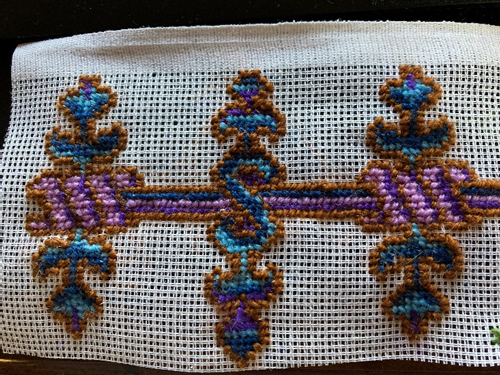
supposed to be my final presentation piece of a Mary Queen of Scots Border, I
used 14 count aida cloth. I did change the color palette from the original blue
to a red/burnt umber. This is to match with the final completion of a future Holbein
carpet with this pattern as the border. With every project I had constant
issues with tension as well as the ground fabric shifting and not laying without
crowding.

Figure 2stitch
crowding can be seen along the faux gold thread
At Academy
of Saint Clare 2023, I discussed this issue with several individuals. They
recommended pushing through with the wool and using a double weave canvas
fabric for my base. They also taught me the trick of retwisting your wool every
few stitches since my tension is so tight, I was making it unravel on its self.
That did help keep the thread from fraying while I was working.
For my final piece I misjudged the
length of the project which meant I had to cut off part of the bottom of the
pattern. I will now use this as a sampler and not for the final goal of the
carpet border. I still used modern cross stitch and tent stitch methods. The
book The Needlework of Mary Queen of Scots does have the historical technique
in it (page 126), but unfortunately my mirroring ability is giving me
difficulty since it shows a right handed method and I am left handed. This is a
skill I am working on completing but in order to figure out design I felt more
comfortable completing in a way I already knew.

Figure 3 larger
weave aida cloth; black outline laid prior to filling


BIBLIOGRAPHY
·
The
Needlework of Mary Queen of Scots by Margaret Swain
·
A
treasury of Embroidery Designs by Gill Speirs and Sigrid Quemby
·
V
&A The Prison Embroideries of Mary, Queen of Scots www.vam.ac.uk/articles/prison-embroideries-mary-queen-of-scots
·
The
Queens embroideries https://blog.edinburghcastle.scot/a-stitch-in-time/
·
extension://nhppiemcomgngbgdeffdgkhnkjlgpcdi/data/pdf.js/web/viewer.html?file=https%3A%2F%2Fwww.edinburghcastle.scot%2Fmedia%2F1127%2Fmqos-replica-embroideries-leaflet.pdf
·
https://tudorembroidery.com/2022/02/09/herladic-embroidery/


Comments
Post a Comment